
1903–1978 · 75 years of presence
Missionary Bishops
of the North Shore
A missionary history told by Father Basile Babin, C.J.M., first archivist of the Canadian Province.
Explore the story ↓Eudist Fathers · Eudist Archives
Eudists on the North Shore
1903–1978
Seventy-five years of presence
For the 75th anniversary of the Diocese of Baie-Comeau, the Archives Service of the Congregation of Jesus and Mary in Charlesbourg prepared this summary of the missionary history of the North Shore. The historical account was written by Father Basile Babin, an Eudist and the first archivist of the Canadian Province.
Seventy-five years ago, in 1903, the Eudist Fathers were entrusted with missionary work along the North Shore of the Gulf of St. Lawrence, a stretch of more than 700 miles from the Portneuf River to Blanc-Sablon. In 1978, their presence continued, though their numbers had declined. The Apostolic Prefecture had come of age and become a diocese in 1945, and the Eudists had formally withdrawn from pastoral responsibility for the territory.
The following pages look back at their work over those 75 years.
The early history
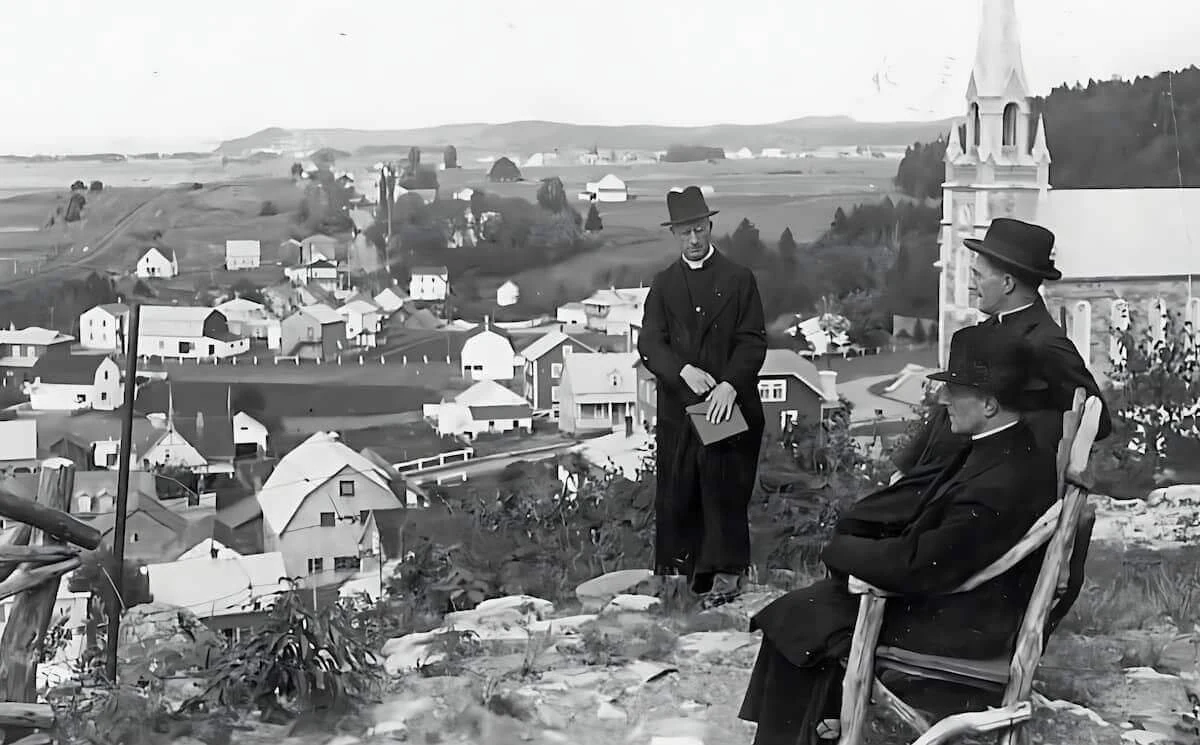
Religious life on the North Shore before 1903
Religious life on the North Shore can, strictly speaking, be traced to before Champlain founded Canada. According to Charles de La Baume de Pontbriand, a companion of Jacques Cartier, the first Mass in Canada was celebrated there in 1534:
“On the tenth day of June, we entered the harbour of Brest (apparently Baie des Roches, a few miles west of Blanc-Sablon, on the Strait of Belle Isle) to take on water and wood. The following day, the feast of Saint Barnabas, we heard the first Holy Mass on the soil of a new world, attended by all our sailors.”
The North Shore was already inhabited by the Innu (Montagnais), who were later evangelized by the Jesuits and then the Oblates. From the beginning, the territory fell under the religious jurisdiction of the Bishop of Quebec, who sent secular and religious missionaries there.
In the early 19th century, Eudist Father Gabriel Lecourtois, driven from France by the Revolution, ministered on the North Shore. He was first assigned to Rimouski (1798–1806), then to La Malbaie (1806–1822), with responsibility for the entire coast at that time.
Over the course of the century, people from Quebec, Jersey, Newfoundland, and Gaspésie settled in this remote territory. Acadians, especially those from the Magdalen Islands, were particularly numerous. They founded Natashquan in 1855, Pointe-aux-Esquimaux in 1857, and Sept-Îles in 1875.
The Diocese of Rimouski was established on January 15, 1867, and its first bishop, Bishop Langevin, was given responsibility for the North Shore. As the population grew, the territory became an Apostolic Prefecture on May 27, 1882. Its first prefect, Bishop F.-X. Bossé, resigned in 1892 after ten years of service. He had made his home in Pointe-aux-Esquimaux, where he built a convent for the Grey Nuns, the Sisters of Charity of Quebec.

1903 · The Eudists arrive
The Eudist Fathers arrive on the North Shore
The North Shore then came under the Diocese of Chicoutimi, established in 1878, rather than the Diocese of Rimouski. The new bishop, Thomas Labrecque, assigned Father J.-F. Gendron to Pointe-aux-Esquimaux while also carrying the responsibilities of bishop and apostolic prefect himself. The double role proved too demanding, so he asked the Holy See to entrust the North Shore to a religious congregation.
In 1902, Bishop Labrecque wanted religious priests to take charge of a working-class parish he planned to establish in the “Bassin” district of Chicoutimi. In Quebec City, he met Father Gustave Blanche, who had founded the Canadian Eudist Province in 1890 and was seeking refuge for confreres expelled from France under the exceptional laws. An agreement was quickly reached. The first two priests arrived in Chicoutimi on January 6, 1903, and on September 10 the Eudist parish of the Sacred Heart of Chicoutimi was officially established.
Father Blanche was appointed Apostolic Prefect of the North Shore on August 21, 1903, three weeks before the parish was canonically established. In October, fourteen missionaries took up residence at seven coastal posts:
- Pointe-aux-Esquimaux Bishop Blanche and Father Joseph Robin. This Acadian parish became the first episcopal see and was then the largest and best-established parish on the North Shore.
- Natashquan Fathers Pihan and Divet, at the easternmost post.
- Magpie Fathers Étienne and Joseph Gallix, uncle and nephew.
- Rivière-au-Tonnerre Fathers Hesry and Louis Héry.
- Sept-Îles Fathers Conan and Brochard.
- Rivière-Pentecôte Fathers Laizé and Louis Nonorgues.
- Manicouagan Fathers Brézel and Garnier, at the westernmost post.
Two of these pioneers drowned while carrying out their ministry: Father Brézel at Manicouagan in 1911 and Father Conan at Sept-Îles in 1908.
At Rivière-Pentecôte, Father Laizé wrote the small newspaper L’Écho du Labrador, published from 1903 to 1905. The Fathers had taught at colleges in France and wrote with ease, so their correspondence and reports in the Eudist magazine of the time are of great interest. The abrupt change in their work makes the sacrifices they accepted all the more striking: they undertook a mission for which nothing had prepared them except the priestly ideal inspired by their founder.
Father Louis Garnier recounted their arrival and settlement in From komatik to airplane, published in Quebec City in 1947 and in France in 1950.

1903–1916 · First bishop
Bishop Gustave Blanche
After his appointment as apostolic prefect in 1903, Father Blanche remained in Chicoutimi, where he organized the assignments of about fifty priests exiled from France. He stayed for two years, until he was raised to the episcopate as Apostolic Vicar of the Gulf of St. Lawrence. He was consecrated in Chicoutimi Cathedral on September 28, 1905.
After his consecration, he settled in Pointe-aux-Esquimaux and then moved to Sept-Îles the following year. Sept-Îles remained the episcopal see until his death in Paris on July 27, 1916, during the General Assembly of the Eudist Fathers.
Bishop Blanche was the providential leader who enabled the Eudists to establish themselves firmly on the North Shore. A priest of remarkable standing and ardent faith, he supported his confreres’ initiatives for the spiritual and material well-being of the faithful. At the time, people expected their parish priest to be a doctor, notary, road builder, and engineer, as well as someone who could secure support from government and patrons. Father Hesry’s skill in this last task became legendary on the Lower North Shore.
Ministry in the lumber camps was also a fruitful and formative apostolic experience.
Five new mission posts opened under Bishop Blanche. In 1904, Anticosti was entrusted to Fathers Travert and Le Strat. In 1907, Father Kerdelhué settled at Rivière-Saint-Jean and Father Conan at Clarke City. After Father Conan drowned on January 17, 1908, Father Émile Jauffret replaced him. In 1909, the Eudists took over the Bersimis reserve from the Oblates, with Fathers Brézel, who drowned in 1911, and Pétel, who drowned in 1919. Father Le Jollec arrived in 1910 and died from a gunshot wound in 1913. These tragedies left deep gaps and raised painful questions among the public.
Alongside the Oblates, the Eudists continued to serve Indigenous communities. At Bersimis, they learned the Innu (Montagnais) language. Father Tortelier revised and expanded the Innu–French dictionary compiled by Oblate Father Lemoine. Later, Father Luc Sirois, who lived at Bersimis from 1934 to 1945, published Montagnais sans maître in 1936, a work praised by the Innu themselves.
In 1910, Father Hesry was sent to Blanc-Sablon. On this “land of Caen,” facing the Strait of Belle Isle, he provided support and companionship for more than twenty years to residents isolated from the rest of the world.
Based on Basile Babin, C.J.M., Eudistes sur la Côte-Nord, 1978.

1917–1920
Bishop Patrice-Alexandre Chiasson
Bishop Chiasson, the first Eudist priest in Canada, was consecrated on October 17, 1917, in Pointe-de-l’Église, Nova Scotia. His time on the North Shore was brief. After a fire destroyed the episcopal residence in Sept-Îles on December 21, 1916, the new bishop returned to the first episcopal residence in Pointe-aux-Esquimaux. It remained the episcopal see until the Diocese of Baie-Comeau was created in 1945.
In 1920, Bishop Chiasson was appointed Bishop of Chatham, New Brunswick. Acadians, whose diocese was four-fifths French-speaking, welcomed the appointment of one of their own. He became one of the great builders of the Acadian Church.
Based on Basile Babin, C.J.M., Eudistes sur la Côte-Nord, 1978.

1922–1938
Bishop Julien-Marie Leventoux
Bishop Leventoux, formerly parish priest on Anticosti from 1912 to 1922, was a scholar who did not know it and a perfect gentleman, as the Honourable Onésime Gagnon liked to say. Father Charles Lebrun, provincial superior at the time, called him “the best of the three bishops” (Garnier, p. 271). Quietly, “as if in hiding,” he worked constantly and wisely for the spiritual interests of the vicariate.
As the North Shore developed, he founded several mission posts: Godbout in 1923 with Father Decq; Shelter Bay in 1926 with Father Louis-Philippe Gagné; Pointe-aux-Outardes in 1930 and Baie-Rouge in 1932 with the future Bishop Labrie; Ruisseau-Vert in 1934 with Father Taillardat, a missionary and colonizer along the Outardes River; and Baie-Comeau in 1936 with Father Gagné, a tireless founder.
In 1927, Bishop Leventoux also founded Saint-Jean-Eudes Hospital in Hâvre-Saint-Pierre. Pointe-aux-Esquimaux officially took that name in 1924.
Based on Basile Babin, C.J.M., Eudistes sur la Côte-Nord, 1978.

1938–1957
Bishop Napoléon-Alexandre LaBrie
Across the vast North Shore, Bishop LaBrie’s name was still on everyone’s lips five years after his death. His story is that of a great religious and social builder whose generous vision, unwavering faith, and courageous perseverance transformed the region.
In 1946, he raised the territory from an apostolic vicariate to a diocese and moved the episcopal see from Hâvre-Saint-Pierre to the new town of Baie-Comeau. Since Baie-Comeau was a company town, he envisioned and founded Hauterive in 1949 as his episcopal city.
He supported Father Taillardat’s colonization efforts at Ruisseau-Vert and Father Arthur Gallant’s at Sainte-Thérèse-du-Colombier. He took a particular interest in the North Shore’s two great natural resources: forests and mines. In 1948, he published a pastoral letter on forestry, which Father André LaBrie praised as one of the most timely documents on the subject. On November 26 of that year, he wrote to Quebec newspapers about the mines of Saguenay and Ungava and their rational development for the benefit of local residents.
After Sainte-Thérèse-du-Colombier was founded in 1938, he established Forestville in 1945 with Father Luc Sirois, who died in service in 1962. In 1953 came Labrieville with Father Robitaille, Labrieville-Sud with Father Gagné, and Chute-aux-Outardes with Father Richard.
The creation of the diocese in 1946 placed the North Shore under the jurisdiction of the diocesan clergy. The Eudists were no longer responsible for supplying priests there. Bersimis returned to the Oblates in 1945 after 36 years of Eudist presence (1909–1945). Baie-Rouge was handed over in 1946 after 14 years (1932–1945), as was Blanc-Sablon after 36 years (1910–1946). Shelter Bay followed in 1947 after 21 years (1926–1947). In 1948, it was the turn of Natashquan after 45 years (1903–1948), Pointe-aux-Outardes after 18 years (1930–1948), and Clarke City after 41 years (1907–1948). Rivière-Pentecôte, after 46 years (1903–1949), and Godbout, after 26 years (1923–1949), were handed over in 1949. Finally, Sept-Îles passed to the diocesan clergy in 1953 after 50 years. This northern Quebec hub had been served by the Eudists for half a century and had hosted Bishop Blanche’s episcopal see until 1916.
Based on Basile Babin, C.J.M., Eudistes sur la Côte-Nord, 1978.
1958–1978
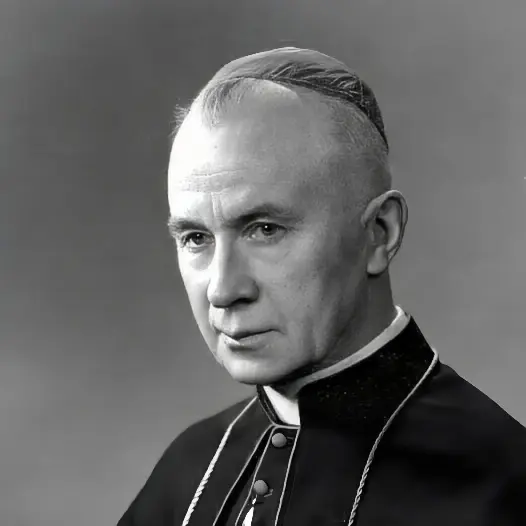
The Eudists’ gradual withdrawal from the North Shore
As secular clergy took the lead in the diocese, the Eudists’ withdrawal continued at a slower pace. In 1958, Ruisseau-Vert passed to the diocesan clergy after 24 years of service (1934–1958); Labrieville followed in 1959 after six years; Labrieville-Sud in 1960 after seven years; Sainte-Thérèse-du-Colombier in 1961 after 23 years; Rivière-Saint-Jean in 1971 after 64 years; and Anticosti in 1973 after 69 years.
In 1978, when the Oblates took charge of Fermont, the Eudists still served a few posts:
- Hâvre-Saint-Pierre the only post continuously served from the beginning (1903–1978);
- Baie-Comeau Sainte-Amélie Parish (since 1936);
- Longue-Pointe-de-Mingan since 1961;
- Gagnon since 1962.
This is the story of the Eudist Fathers’ 75-year missionary adventure on the North Shore. We look back with pride and, above all, with gratitude for the work of these French pioneers, driven from their homeland by persecution in 1903.
Digitized archives
Read the full document
The 1978 archival version contains the complete account and its historical detail.
Also discover: The Fathers of the North Shore (1903–2017) →